SF Bay Area / Food guide
Korean donkatsu and Japanese tonkatsu: what changes on the plate?
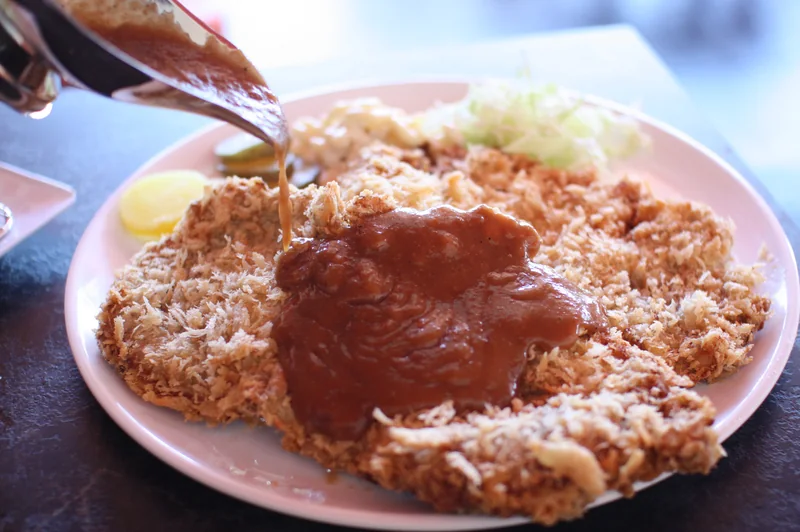
Read the guideKorean donkatsu and Japanese tonkatsu both start with a breaded pork cutlet. For someone choosing a meal, useful differences to look for are the thickness of the meat, the sauce and the way the plate is served. The wide, thin Korean cutlet is one familiar style; individual restaurants offer their own versions.
Relationship & reporting note
King Katsu Land is a client of MIK Company, which operates Roundmoa. This guide draws on published sources and menus; it is not a firsthand dining review.
Before you order
Start with what’s on the plate.
These examples help you read a menu. Each restaurant has its own preparation.
The cutlet
A thin, flattened Korean donkkaseu and a thicker Japanese tonkatsu offer different starting points.
Read moreThe sauce
Gravy, regular or spicy sauce, and miso sauce are examples to look for in the actual description.
Read moreThe topping
At King Katsu Land, compare the original cutlet with Cheese Katsu and Snowflake Cheese Katsu.
Read moreStart with the cutlet and sauce
Maangchi’s Korean donkkaseu recipe illustrates a thin cutlet that is flattened before breading and served with rice and gravy. It is a useful example of the Korean Western-style restaurant tradition called gyeongyangsik. Korean donkkaseu example
Taste of Japan describes Japanese tonkatsu using thicker pork cuts, with loin and tenderloin among the choices. Its guide also includes miso katsu, a reminder that Japanese preparations have more than one sauce. Japanese tonkatsu guide
Use those descriptions as a starting point when reading a menu. A national label alone will not tell you the exact thickness, portion or sauce at a particular restaurant.
Reading a Korean katsu menu in the Bay Area
King Katsu Land describes its King Katsu as a wide, thin pork cutlet and offers regular or spicy sauce. Cheese Katsu and Snowflake Cheese Katsu are also listed; the latter is described as topped with shredded cheese. Compare those details before choosing between the original cutlet and a cheese option. King Katsu Land’s official menu and locations
For a first order, start with what you want to learn about the dish. Choose the basic cutlet to focus on the meat, breading and sauce. Choose a cheese version if that topping is what brought you to the menu. These are ordering suggestions, not tasting scores.
Choose the California location before ordering
The restaurant lists two Bay Area addresses: 2085 Gellert Blvd #6 in Daly City and 5890 Mowry School Rd in Newark, California. Choose your branch on the official site before opening an ordering service. Check that service’s current menu and prices rather than assuming that both branches or every delivery platform are identical. Official locations
If you are still choosing a meal elsewhere in the region, browse Roundmoa’s SF Bay Area restaurants.
Two questions before you order
Does “katsu” always mean pork? Tonkatsu refers to pork, while menus can use katsu for other cutlets. Read the complete dish name and description when the protein matters.
Should I choose Korean or Japanese katsu? Look at the restaurant’s actual preparation. A thin cutlet with gravy and a thicker cutlet with a different sauce offer different meals; the label does not make one a better choice for everyone.
Plan your visit
Choose your Bay Area location.
Select the correct branch before opening its ordering service. Menus and prices can differ.
King Katsu Land · Daly City
2085 Gellert Blvd #6, Daly City, CAOfficial menuKing Katsu Land · Newark
5890 Mowry School Rd, Newark, CAOfficial menuROUNDMOA / EDITORIAL
Sources & editorial note
Food descriptions and restaurant information were checked on September 25, 2026. Menu options can change. AI assisted with drafting and translation.
- 01Korean donkkaseu example
- 02Japanese tonkatsu guide
- 03King Katsu Land’s official menu and locations
- 04Official locations
King Katsu Land is a client of MIK Company, which operates Roundmoa. This guide draws on published sources and menus; it is not a firsthand dining review.
Our editorial approach